Skip to content
Blown-in insulation reduces high electric bills in Naples FL

Blown-In Insulation in Naples FL: Cost, Benefits, and What Homeowners Actually Need to Know

Ideal Insulation
Ideal Insulation

Your Naples Attic Is Probably Costing You Hundreds a Year

If your FPL bill makes you wince every summer — and let's be honest, that's most of us in Collier County — there's a good chance your attic insulation is the problem. Blown-in insulation in Naples, FL is one of the fastest, most affordable ways to fix that. We're not talking about a full gut-and-redo. We're talking about a crew showing up, blowing loose-fill insulation into your attic in a few hours, and you noticing the difference on your next electric bill.

At Ideal Insulation, we install blown-in insulation across Naples, Fort Myers, and the rest of Southwest Florida. We've done thousands of attics, and we see the same thing over and over: homes built in the '90s and 2000s with thin, compressed fiberglass batts that have been baking in 150°F+ attic heat for decades. That stuff isn't doing its job anymore.

So let's talk about what blown-in insulation actually is, what it costs, and whether it makes sense for your home.

What Exactly Is Blown-In Insulation?

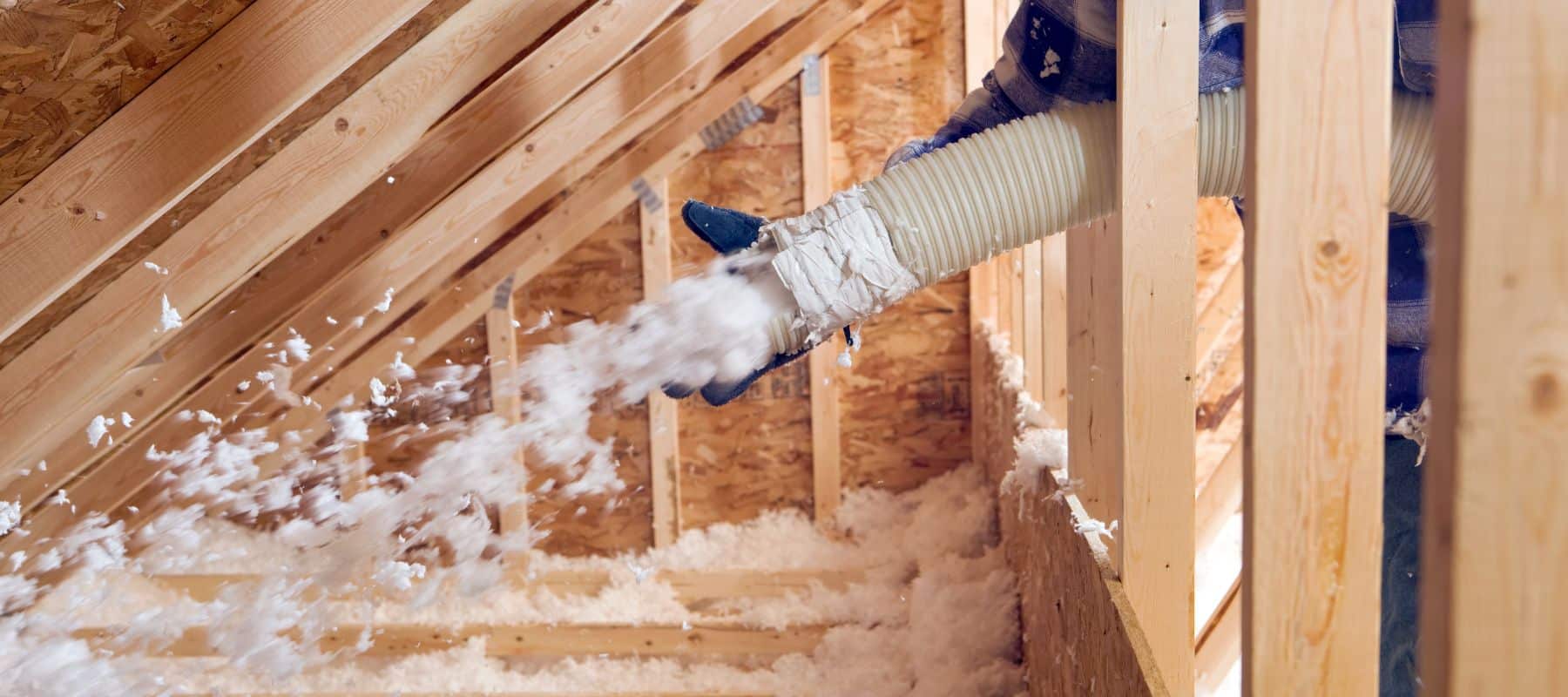
Blown-in insulation (also called loose-fill insulation) is exactly what it sounds like. Small pieces of insulation material get blown into your attic through a large hose connected to a blowing machine. The material fills gaps, settles around obstructions like wiring and ductwork, and creates a thick, even blanket of thermal protection across your attic floor.

There are two main types you'll see in SWFL:

Fiberglass loose-fill — Made from spun glass fibers. It's lightweight, doesn't absorb moisture, and won't settle as much over time. Most common choice for attic top-ups and retrofits. R-value runs about R-2.5 per inch, so you need a decent depth to hit code.

Cellulose — Made from recycled paper treated with fire retardant (usually borate). Slightly higher R-value per inch (around R-3.2 to R-3.8), denser, and does a better job filling irregular cavities. It can absorb some moisture though, which matters in Florida's humidity. [NEEDS VERIFICATION: specific R-value per inch for cellulose products installed in SWFL]

Both work. Both are cost-effective. The right choice depends on your attic's condition, your budget, and what's already up there. We'll get into that.

Why Naples Homeowners Are Adding Blown-In Insulation Right Now

Here's the reality of living in IECC Climate Zone 1 (that's us — Naples, Marco Island, Bonita Springs, all of Collier and Lee counties). Our cooling season runs roughly nine months. Your AC isn't a luxury; it's life support from April through November.

And your attic? During summer, surface temperatures up there hit 150°F or higher. If you've got thin or degraded insulation, that heat radiates straight down into your living space. Your AC runs harder, longer, and your FPL bill climbs.

We've pulled out old insulation in Pelican Bay condos, Golden Gate Estates ranch homes, and Lely Resort villas — and found maybe R-11 or R-13 worth of compressed fiberglass where there should be R-30. That's the Florida Building Code minimum for vented attics (FBC 8th Edition, 2023), and a lot of homes aren't even close.

Adding blown-in insulation to get up to R-30 or beyond is one of the best bang-for-your-buck energy upgrades you can make. We're talking potential energy savings of 15-25% on cooling costs, depending on what you're starting with. [NEEDS VERIFICATION: 15-25% energy savings range — varies by home, source needed]

Blown-In Insulation vs. Other Options: An Honest Comparison

You've got choices. Here's how blown-in stacks up against the alternatives we install:

Feature Blown-In (Loose Fill) Fiberglass Batts Open Cell Spray Foam Closed Cell Spray Foam
Cost (per sq ft installed) $0.80 – $1.50 [NEEDS VERIFICATION: blown-in pricing range] $0.50 – $1.20 [NEEDS VERIFICATION: batt pricing range] $0.40/inch/sq ft (~$2.00/sq ft at 5") $1.00/inch/sq ft (~$3.00/sq ft at 3")
R-Value Per Inch R-2.5 to R-3.8 R-3.1 to R-3.4 ~R-3.7/inch ~R-6.5 to R-7.0/inch
Air Sealing Minimal None Yes — excellent Yes — best
Moisture Barrier No No (vapor retarder with kraft face) No Yes (at 1.5"+)
Install Time (avg attic) 2-4 hours 4-8 hours 3-5 hours 3-5 hours
Best For Attic floors, top-ups, budget jobs Open wall cavities, new construction Attic rooflines, crawlspaces Exterior walls, flood zones, max R-value

Here's my honest take: blown-in insulation is the sweet spot for most Naples homeowners who need an attic upgrade on a budget. It's fast, it's affordable, and it gets you to code. But it doesn't air seal. If your attic has gaps around can lights, plumbing penetrations, or duct boots, we'd recommend air sealing those first, then blowing insulation on top. That one-two punch makes a real difference.

Spray foam is the premium play — especially open cell on the roofline if you want to bring the attic into conditioned space. But it costs more. A lot more. For a straightforward attic floor insulation job, blown-in usually makes the most sense financially.

How Much Does Blown-In Insulation Cost in Naples, FL?

Pricing depends on a few things: your attic's square footage, how accessible it is, whether old insulation needs removal first, and what R-value you're targeting.

Here are rough ranges for the Naples/Fort Myers area:

  • Blown-in fiberglass (attic floor, ~R-30): $0.80 – $1.50 per square foot installed [NEEDS VERIFICATION: current blown-in fiberglass pricing]
  • Blown-in cellulose (attic floor, ~R-30): $0.90 – $1.60 per square foot installed [NEEDS VERIFICATION: current blown-in cellulose pricing]
  • Old insulation removal + new blown-in: Add $1.00 – $2.00 per square foot for removal [NEEDS VERIFICATION: removal pricing]

For a typical 1,500 sq ft Naples home, you're looking at roughly $1,200 to $2,250 for blown-in insulation alone. If we need to pull out old stuff first (which we often do — rodent-damaged, water-stained, or just ancient), the total project might run $2,500 to $5,000+. [NEEDS VERIFICATION: total project cost ranges]

Compare that to spray foam on the same attic: open cell at $0.40/inch/sq ft for 5 inches comes to about $3,000 for 1,500 sq ft. Closed cell at $1.00/inch/sq ft for 3 inches would be $4,500. Blown-in is clearly the budget-friendly winner when you're insulating an attic floor.

We give free estimates — no hard sell, just honest numbers. Call us or book online.

The Installation Process: What to Expect

People are always surprised how fast this goes. Here's the typical process when our crew shows up:

1. Inspection and prep (30-60 min). We check your attic access, look for moisture issues, assess existing insulation, and make sure there's nothing weird going on — knob-and-tube wiring, active leaks, vermiculite (yes, we've found it in older Naples homes). We'll also check for proper attic ventilation. Blown-in insulation needs soffit baffles to keep from blocking airflow at the eaves.

2. Air sealing (if included). We seal gaps around penetrations with caulk and canned foam. This step is optional but strongly recommended. Insulation slows heat transfer; air sealing stops hot air from moving through gaps. You want both.

3. Installing baffles. Styrofoam or cardboard baffles go at each soffit vent to maintain airflow from soffit to ridge. Skip this and you risk moisture problems and reduced ventilation. We don't skip it.

4. Blowing the insulation (1-3 hours). One crew member feeds material into the blowing machine outside. Another is in the attic with the hose, working section by section, building up to the target depth. For R-30 with fiberglass loose-fill, we're looking at about 10-12 inches of material. [NEEDS VERIFICATION: exact depth for R-30 with specific fiberglass product]

5. Cleanup and walkthrough. We clean up, show you photos of the finished attic, and leave depth markers so you (or a future home inspector) can verify the insulation level.

Most jobs are done in half a day. You don't need to leave the house. It's not messy. And you'll feel the difference within 24 hours if your old insulation was really shot.

Do You Need to Remove Old Insulation First?

Not always. And this is where some contractors will try to upsell you.

If your existing insulation is:

  • Dry, intact, and pest-free — we can blow right on top of it. Layering new insulation over old is perfectly fine and saves you money.
  • Water damaged or moldy — it needs to come out. Wet insulation loses R-value and can cause structural issues.
  • Contaminated by rodents or pests — removal and sanitization first. We see this more than you'd think in Golden Gate Estates and East Naples.
  • Vermiculite (pre-1990 homes) — don't touch it yourself. It may contain asbestos. Get it tested first.

We'll tell you honestly whether removal is necessary. If it's not, we won't push it. That's not how we operate.

Naples Building Code Requirements You Should Know

Florida's building code (FBC 8th Edition, 2023) sets minimum insulation requirements based on climate zone. Naples and all of Southwest Florida fall in IECC Climate Zone 1.

Here's what the code requires:

  • Vented attic (insulation on attic floor): R-30 minimum
  • Unvented attic with spray foam on roofline: R-20 accepted per FBC Section R806.5 — but this requires a blower door test showing less than 3 ACH50 plus mechanical ventilation
  • Walls: R-13 minimum

If you're doing a renovation that requires a permit, the inspector will check insulation levels. Even if you're not pulling permits, meeting or exceeding R-30 in your attic just makes sense for comfort and energy savings in our climate.

Quick note: some websites and even some contractors will tell you Naples is in Climate Zone 2. It's not. We're Zone 1. The requirements are different. Make sure whoever you hire knows the local code — it's a red flag if they don't.

FPL Rebates and Energy Incentives

FPL (Florida Power & Light) offers rebates for insulation upgrades through their energy efficiency programs. As an FPL Preferred Insulation Contractor, Ideal Insulation can help you navigate the rebate process.

Rebate amounts and eligibility change periodically, so we always recommend checking FPL's current program or asking us during your free estimate. We handle the paperwork for you when rebates are available. [NEEDS VERIFICATION: current FPL rebate amounts and program details for blown-in insulation]

Why Hire Ideal Insulation for Blown-In Insulation in Naples?

Look — there are other insulation companies in town. Here's why our customers keep choosing us (and referring their neighbors):

We're local and we're not going anywhere. We service Collier, Lee, and Charlotte counties. That's it. We're not a franchise. We're not a national chain sending subcontractors. Our 17 installers work for us directly, and our 9 trucks are on SWFL roads every day.

We know the local code inside and out. IECC Zone 1 requirements, FBC 8th Edition specs, hurricane strap clearances, proper ventilation — this stuff matters and we don't cut corners.

FPL Preferred Contractor. That designation means FPL has vetted our work quality and we can process rebates directly. Not every insulation company in Naples has it.

We do all types of insulation. Blown-in, spray foam (open cell and closed cell), batt, removal, and air sealing. If blown-in isn't the right fit for your situation, we'll tell you. We've got the alternatives in-house — we're not limited to one product.

Free thermal scans. We use infrared cameras to show you exactly where your home is losing energy before we start any work. No guessing.

Blown-In Insulation for Naples New Construction

Building a new home in Naples? Blown-in insulation works great for wall cavities in new construction too. The process is called BIBS (Blown-In Blanket System) — netting gets stapled over open wall cavities and insulation is blown in to fill the space completely. No gaps, no voids, no compressed batts that don't quite fit.

We work with builders across Collier and Lee counties on new construction projects. If you're a builder or GC reading this, give us a call — we bid competitive and we show up on schedule. That second part matters more than you think in this market.

Frequently Asked Questions About Blown-In Insulation

How long does blown-in insulation last?

Fiberglass loose-fill can last 20-30 years or more if it stays dry and pest-free. Cellulose has a similar lifespan but is more susceptible to moisture degradation in humid climates like ours. The bigger issue in SWFL isn't age — it's whether your attic ventilation is working properly and keeping moisture out. We check that on every job.

Will blown-in insulation help with hurricane season?

Insulation doesn't make your roof stronger — that's straps, clips, and proper framing. But a well-insulated, properly sealed attic does reduce wind-driven moisture intrusion and helps maintain interior conditions if you lose power during a storm. After Hurricane Ian in 2022, we saw plenty of attics where water had gotten in and destroyed the insulation. Proper installation with maintained ventilation reduces that risk.

Can I install blown-in insulation myself?

You can rent a blowing machine from Home Depot or Lowe's. Will it be installed correctly? Probably not. The most common DIY mistakes: blocking soffit vents, uneven coverage, insufficient depth, and not air sealing first. For a few hundred dollars more than DIY materials, professional installation gets you even coverage, proper ventilation, and a warranty. Your call, but we fix a lot of DIY jobs.

Is blown-in insulation safe? Does it contain formaldehyde?

Modern fiberglass loose-fill insulation is formaldehyde-free. Cellulose is treated with borate for fire resistance and pest deterrence — it's safe for residential use. Neither product off-gasses significantly after installation. If you have specific chemical sensitivities, let us know and we can discuss product options.

How do I know if my current insulation needs replacing or topping off?

Easiest way: look in your attic. If you can see the tops of the ceiling joists, you don't have enough insulation. Those joists are typically 6-8 inches deep, and you need 10-12+ inches for R-30. Also look for: dark spots (air leaks), pest droppings, water stains, or a musty smell. Or just call us for a free thermal scan — the infrared camera doesn't lie.

Get Your Free Estimate and Thermal Scan

If you're a Naples, Fort Myers, or SWFL homeowner wondering whether blown-in insulation makes sense for your home, here's what to do: call us. Seriously. The estimate is free, the thermal scan is free, and there's no pressure.

We'll inspect your attic, show you the infrared images, and give you an honest recommendation — whether that's blown-in, spray foam, or just some air sealing. Sometimes the answer is "your insulation is fine, your ductwork is the problem." We'll tell you that too.

Ideal Insulation Inc.
Naples, FL — Serving Collier, Lee & Charlotte Counties
📞 (239) 265-0242 [NEEDS VERIFICATION: phone number]
🌐 idealinsulationinc.com
Licensed & Insured | FPL Preferred Insulation Contractor

Schedule Your Free Estimate →

Share this post